
What Your Wedding Photos Will Say About You in 30 Years
What Your Wedding Photos Will Say About You in 30 Years
Open your parents' wedding album. Or better yet, your grandparents', if you are lucky enough to have one. Look at the images. Really look. Not the hairstyles. Not the suits. Not the moustaches or the shoulder pads. Look at the faces.
There is something in those old photographs that stops you. Your grandmother's gaze at twenty-three, a flower in her hair, her eyes full of a future she does not yet know. Your grandfather's hand on his wife's waist — a young hand, strong, full of promises. The smile of that aunt you only knew old, and that you suddenly discover radiant, carefree, beautiful.
These photographs move you. Not despite their age — because of their age. Time has erased the fashions, the trends, the affectations. It has left only the essentials: human beings who loved each other, on a specific day, in a specific place.
Now ask yourself the question nobody asks during the wedding preparations: in thirty years, what will your photos say about you?
The Trap of Photographic Trends
Every era has its photographic fashions. And every era is absolutely convinced that its fashions represent the pinnacle of art.
The 2000s had the hyper-contrasted black and white, the dramatic poses, the excessive backlighting. The 2010s saw the explosion of vintage filters, washed-out tones, images so retouched they looked like perfume advertisements. The early 2020s cemented the earthy-toned presets — those images with desaturated colours, greens turned toward brown, strangely orange skin, giving the impression that every wedding took place in a wheat field at sunset, even when it happened in a Parisian restaurant in January.
Each of these trends seemed magnificent at the moment it dominated. Each is today dated in a way that is almost embarrassing. Not because they were ugly — they were not — but because they overlaid an aesthetic filter onto reality. They said more about the era than about the couple.
The problem is that your wedding is not an era. It is a moment in your life. And the images that document it should speak about you, not about what was trending on Instagram the year you got married.
What Ages Well (And Why)
After sixteen years of wedding photography, we have an advantage that few photographers possess: perspective. We have photographed weddings in the mid-2000s. We have watched our own images traverse time. And we know, with the certainty of experience, what holds and what crumbles.
What ages well, always, without exception, are images that respect three principles.
True-to-life colour. Skin looks like skin. The sky is blue when it is blue. Green is green. The colours of your wedding — the ones you chose with care, the flowers, the outfits, the décor — are rendered as they actually were. In ten years, twenty years, thirty years, these images will look like a window open onto a real moment, not an artistic interpretation that has aged badly.
Authentic expressions. Forced poses reveal themselves at first glance, especially with the passage of time. The frozen smile, the calculated posture, the "photogenic" gaze directed at a precise point — all of it screams staging. What crosses decades without acquiring a single wrinkle are the real expressions. The laugh that crinkles the eyes. The surprise that opens the mouth. The emotion that cannot be controlled. Those images never date, because humanity is not a trend.
Classic composition. Eccentric framings — extreme angles, radical off-centres, invasive artistic blurs — are seductive in a contemporary portfolio. But the photos you will hang on your wall for thirty years are almost always those whose composition is readable, balanced, harmonious. Not boring — harmonious. There is a vast difference.
The Mistake That Even the Most Savvy Couples Make
Here is the paradox. The most informed couples, those who have spent hours on Pinterest and Instagram studying photographic styles, are often the ones who fall most easily into the trend trap. Why? Because their eye is shaped by what they see online. And what they see online, by definition, is what is popular right now.
A couple who arrives at our first meeting with a moodboard composed entirely of moody images, deep shadows, and desaturated colours is not asking us for "our style." They are asking us to reproduce the dominant style of 2024. It is not a criticism — it is human. We love what we see. We want what we know.
Our role, as professionals who have traversed five generations of trends, is to ask a simple question: do you love these images because they look like you, or because they look like what everyone finds beautiful right now?
The nuance is crucial. Some couples are naturally dark, dramatic, contrasted — and moody images genuinely suit them. Others are luminous, joyful, sunlit — and forcing them into a dark palette would be a mistake. The photographic style of your wedding should reflect who you are, not what is trending.
The Thirty-Year Test
We often propose a mental exercise to our couples. Imagine yourself at sixty. Your children have grown. Perhaps you have grandchildren. One Sunday afternoon, someone pulls out the wedding album. Everyone gathers around.
What do you want to see in those pages?
Do you want to see a collection of perfectly edited images, in an impeccably contemporary style, that look like a magazine cover from 2026? Or do you want to see your day as it truly was — the real light of Mauritius, the real colours of the ocean, the real faces of the people you love, the real emotions that moved through you?
It is not a rhetorical trap. There is no wrong answer. But the question deserves to be asked before choosing a photographer, because it fundamentally determines the type of images you will receive.
Couples who pass this test almost invariably choose authenticity over trend. Not because they reject aesthetics — on the contrary. But because they understand that the most enduring beauty is the one that does not disguise itself.
Why Mauritius Changes the Equation
There is an argument specific to weddings in Mauritius that we must mention, because it profoundly changes the aesthetic equation.
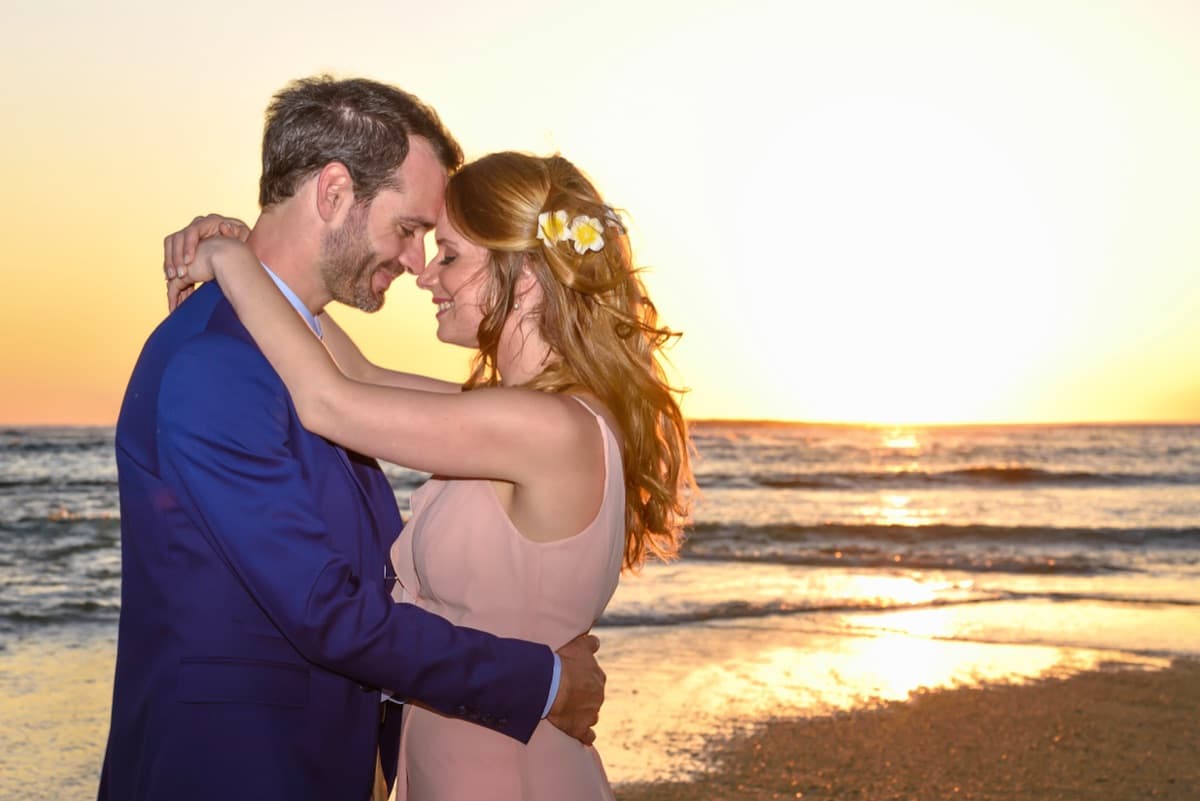
Mauritius is already spectacular. The tropical light needs no filter. The turquoise water needs no artificial saturation. The lush green of the vegetation needs no darkening or modification. The sunsets of the Indian Ocean need no retouching to be breathtaking.
When you marry in a setting that is naturally extraordinary, the best photographic decision is often the simplest: capture faithfully what is there. Every filter, every colour manipulation, every "creative correction" moves the image away from a reality that, in Mauritius, is already more beautiful than most retouches try to manufacture.
We see it every week. The most powerful images in our portfolio are not the ones where we pushed the processing. They are the ones where we trusted the light of Mauritius, composed with care, waited for the right moment, and let reality do the work.
In thirty years, when you look at these photos, you will not see a photographic style. You will see Mauritius as it was that day. And it will still be just as beautiful, because natural beauty never goes out of fashion.
How to Choose a Timeless Style Without Falling Into the Boring Classic
The legitimate fear couples have when talking about timelessness is boredom. "Timeless" does not mean "conventional." It does not mean rows of frozen portraits against neutral backgrounds. It does not mean giving up creativity, boldness, personality.
Photographic timelessness is a matter of foundation, not limitation. True-to-life colours do not prevent a bold composition. Authentic expressions do not prevent an inventive framing. Natural processing does not prevent masterful play with light, reflections, shadows, and textures.
The best wedding photographers — and we strive to be among them — create images that are both contemporary and enduring. That have the energy of their era without its affectations. That surprise today and will still move in three decades.
It is a subtle balance. It demands experience, discernment, and a deep understanding of what endures. It is precisely what sixteen years of work have taught us — not in books, not in tutorials, but in the long view, watching our own images evolve and understanding which ones have gained strength with the years.
Questions to Ask Your Photographer
When you meet a wedding photographer, here are the questions that will help you evaluate the durability of their approach.
"Can you show me weddings you photographed five years ago, eight years ago, ten years ago?" A photographer who has only recent images in their portfolio cannot prove that their style ages well. Ask for the proof of time.
"Has your style evolved? How and why?" The right answer is not "no, my style is constant." The right answer is an honest reflection on what has changed, what has matured, what has been abandoned because it did not hold up over time.
"What is your approach to colour processing?" Photographers who favour the natural will talk about fidelity, calibration, respect for real tones. Those who follow trends will talk about presets, looks, specific aesthetics. Both approaches are defensible — but they produce very different results in the long term.
"When you look at your very first wedding photos, what would you change?" This question reveals the honesty and maturity of a photographer. Anyone who claims to have no regrets is either lying or has not gained enough perspective to be honest.
What Our Photos from Sixteen Years Ago Taught Us
We began photographing weddings in Mauritius in 2009. Our earliest images were competent. Technically correct. Aesthetically aligned with what was being done at the time. But when we look at them today, we see certain things we would no longer do. Processing that was too heavy. Framings that were too confident. Moments of staging where we should have let life unfold.
What time has taught us is humility before reality. The images from our earliest years that have aged best are the ones where we intervened the least. Where the light of Mauritius did the work. Where a couple's emotion was so powerful that all it took was being there, in the right place, at the right moment, with the right framing — and pressing the shutter.
These are the photos that couples come back to thank us for taking, years later. Not the most spectacular. Not the most technical. The most true.
And it is this lesson — learned slowly, sometimes painfully, always with gratitude — that guides every wedding we photograph today. We no longer seek to impress. We seek to preserve.
Because in thirty years, what will matter is not that your photos were on trend. It is that they were faithful.
Nat & Jude have been photographing weddings in Mauritius since 2009 — long enough to know what lasts. Sixteen years of images, one principle: truth ages better than trend.
Discover our approach.
Related Services
Honeymoon Photo Session
Immortalize your honeymoon with a romantic photo session on the most beautiful beaches of Mauritius
Wedding Photography
Capture every precious moment of your wedding with our expertise of over 16 years
Couple Photo Session
A romantic photo session to celebrate your love in paradisiacal settings